Monday, December 22, 2014

Blog Post #8


2.        Double Indemnity contains several elements in its setting, storyline, and characters that creates a generally dark and depressing atmosphere. The setting itself play a major role in this, as well as the cinematography. Most of the movie takes place indoors, in dimly lit, smokey rooms. This creates an ominous mood even before the action of the movie begins and destroys any cheeriness in the movie. Furthermore much of the movie happens at night which adds to the mood of secrecy that is brought about by the characters and other settings. The cinematography also adds to these aspects. In the outdoor scene the characters are often to the side of the screen, hiding or wishing to not draw attention such as when Walter hides in the bushes from Niko. Also the dim lighting combined with small spaces indoors forces the camera close to the characters which makes their grim facial expressions more noticeable, further making the film seem more serious and morbid.
          The storyline also goes to create a depressing and dark film, as it only displays the bad in humanity. Walters lust leads him to commit murder for a person he barely knows, showing an outstanding man in society so easily corruptible. Also when he and Phyllis turn on one another and he has to trap Niko to get out of suspicion, he turns on the only person he thought he could trust making the story more depressing.
          Lastly the characters create a "Black Film" in their actions and in their dress. Throughout the film, Walter wears dark, formal attire making him seem very stiff and depressed. He never wears a light colored jacket and is constantly wearing an overcoat as well, which has become associated with suspicious activity in modern society. Phyllis isn't dressed as grimly in the movie, and plays more to the promiscuous role, as seen in the first scene where she isn't wearing clothes at all, only a towel. Also the personas they take on, both premeditative and lacking compassion, add to the depressing and dark nature of the film/film style.
     

Sunday, December 14, 2014

Macduff's Netflix

Login: macdaddyduff
Password: ilovescotland1


"Braveheart"
A movie about a Scottish man whose village is attacked by the English and wife is murdered. He goes on to lead a motley crew of Scotsmen against the English army and has a great monologue before the final battle. Macduff would love this movie because it too portrays a deep love of Scotland and the fight against a tyrant over what is right, which is one of his favorite things. Also, it doesn't say that Macduff didn't have blue face paint in the final battle of Macbeth.


"Gladiator"
A movie about a great commander of the Roman army who is very close with the ailing emperor. The emperor's son murders his family and the emperor and attempts to kill him too. Russell Crowe then comes back and reveals his identity after becoming a beloved gladiator and kills Joaquin Phoenix (the new emperor) in front of all of Rome. This is perfect for Macduff because it might as well have been ripped right out of the plot of Macbeth. Macduff's family is murdered by the king's murderer, like in gladiator, and also he goes on the kill the man who betrayed the beloved leader.


"Prison Break"
A TV show about a man whose brother is wrongly sentenced to death for a murder he didn't commit. He also conveniently designed the prison that his brother is incarcerated at, and he goes in to break him out, hence the name. This applies to Macduff, because he isn't afraid to go against the government to do what he knows is right, just like Michael Skofield (the main character of Prison Break). Furthermore they are both motivated in their fights by family.


The Hunger Games Mockingjay part I and II
Do I really need to summarize? Katniss Everdeen fights against the capital as a symbol of the rebellion following the end of the quarter quell. She see's the damage to her old district and it motivates her to fight and reinspires her to hate the capital. This is something Macduff would like because it involves a fight against an unjust government, and a main character that is motivated by the loss of their family/home. They use this anger to go through with their fight against the corrupt government and in the end, both triumph.


Wednesday, November 19, 2014

Witch-Slapped 4

The societal definition of a "good man" has changed in several ways since the time of Macbeth. Furthermore I would argue that even the definition of a "manly man" has changed in some ways, like that soldiers are not longer glorified for their actual feats in battle (medals excluded) but for their service as a whole.


In modern times, a good man is judged less, or not at all, at his ability in battle, unlike in Macbeth when he is described in the second scene of act one as a ferocious warrior is praised for such. However, a mans ability to fight is still a part of his worth, but not as consciously judged. In modern times a man's strength is applied to his ability to fight and protect his woman, like correlating arm size to punching strength, and is much more speculative. In medieval times, a man's ability to fight was much more proven than estimated, such as in a duels, which (unfortunately) don't exist today. In addition to this, weapons can be attributed to manliness in both time periods. In the time of Macbeth, most men would know how to use a sword and carry one. Today, however, much fewer people believe that carrying weapons is sign of manliness, and also fewer people know how to use them.


Additionally, in today's society, the value of a man is placed much more on how he treats others at home and his success in life. While men are no longer considered the only providers in a family, I still think that society in general expects the man/husband in a relationship/marriage to have a respectable position and earn money for his family. Even in progressive times, it is still against societal conventions to be a stay at home dad, or even to have a "woman's job" such as a nurse. This is somewhat similar to Macbeth, as he is responsible for taking care of Lady Macbeth, but in those times the woman was not allowed to work. Also somewhat akin to that of old times, men are expected to do the dirty work. It isn't quite to the same extent that it was in Macbeth's time, where he had to be the one to kill Duncan, but men today are still expected to do yard work and construction opposed to women.

Lastly, one difference between the times in that now men aren't looked down upon for relying on their ladies for emotional support. Macbeth's own wife asked if he was a man when he began to freak out after killing Duncan, but nowadays a man can talk about his feelings to his significant other without being made fun of by that very own person.

Sunday, November 9, 2014

#IBViewingArt

View WP_20141109_002.jpg in slide showView WP_20141024_12_15_22_Pro.jpg in slide show


The artwork above on the right is called "Blind self portrait listening to the beetles while scratching a notched stick so to invoke, the universal magic of the power of destruction" by Abraham Cruzvillegas, and was created as an acrylic on paper medium in 2013.


The style is abstract, and is made in a modern period. The original location of the work is likely Mexico, as that is where the artist is from and no other information about the artist or the artwork was given.


The work represents the idea of "limited visibility" and does so by painting the back of several different papers and facing the unpainted side against the wall. Some of the 168 pieces included black and white pictures and letters (yes, I looked behind them when no one was looking) which seem to have no correlation other than their obscurity. The lack of information given to the viewer on the right side of the work supports the theme of limiting visibility and creating vagueness, as well as the abstract title.


The artist worked little with line or value, as the entire composition is one shade of tan and contains no shapes on the pieces of paper themselves. The forms are represented in a disorganized matter which adds to the confusion of the piece and its lack of traditional art principles. Furthermore the movement of the work doesn't have a clear direction and it lacks a central point of focus. Together, these techniques combine to create even more ambiguity to the already unclear concept of limited visibility, further emphasizing the artist's idea.


Overall, the purpose of the work is to open the viewer's mind to the unknown and inspire their curiosity and imagination as to what could be behind the paint. The piece worked well as an opening part of the museum's theme of limited visibility by being an outright example that started an artistic thought process and wasn't too difficult to digest. The piece is meant to create uncertainty as to what it means, as shown in the title and the work. The beetles could mean insects or the band, and it is up to the viewer to interpret everything based on a lack of stimuli.

Thursday, October 23, 2014

Seven Deadly Sins in Ads


The author of this image is Frank Miller, shown by the small print on the left side saying "View the rest of the Frank Miller collection at Gucci Guitly.com," but the date of publication for the image is unknown, The image was published on thescentedhoud.file.wordpress.
The denotative explanation for this advertisement is that there is a man, shirtless and with swirly chest hair, being held tightly and possibly smelled by an attrative, and for what we can see, shirtless woman. Also the words "Gucci Guilty pour homme" and "The new fragrance for him" appear on the ad. Additionally, the all black background forces the viewer to focus on the two people in the image, and also makes the bottle superimposed on top of them pop even more. The viewer's eyes are also guided through the ad. Likely being surrounded by text, the first thing the viewer would do is begin to read the advertisement from top down. This would lead them to seeing the man, then the woman clinging to him, and finally the bottle of cologne.
The connotative explanation is centered around lust. For men, the image is meant to relay the message that if you purchase this cologne, you too can be tightly held and possibly sniffed by attractive shirtless women. This is shown through the movement of the piece described earlier, as the man would see the man being stuck to the women, and the bottle representing the cause of this. Sex appeal is meant to incite desire within male viewers and therefore convince them that they will be found more attractive by women if they wear this fragrance. The lusty approach can also apply to women too. A woman may buy her boyfriend/husband/significant other this cologne, shown by the words "For Him," on the image. The attractive man may be included to also elicit desire within women and encourage the conclusion that if their man wears this cologne he will be more attractive.
The intended audience of the image includes both men and women, as shown by the analysis above. The social background would most likely be younger men and women around their twenties and early thirties, and economically middle to upper middle class. Older people would tend to be less swayed by such a sexual ad and younger people less likely to wear cologne. Also, lower class people cannot afford frivolous expenses like cologne and the wealthy most likely have someone pick out cologne for them. Cultural knowledge isn't a significant factor in the ad as it does not include any references to pop culture and relies on simple human desires and conclusions. 

Sunday, September 28, 2014

What's in a name?

Bradley Eudore Wilhelmy Jr.


My name doesn't have much significance in the sense that it doesn't mean anything. I was named after my dad, hence the junior, and my/our middle name comes from my great uncle. I don't really like my middle name, it's too weird and doesn't fit me very well as I don't relate to much of my French heritage. Although I'm impartial about my name, it would be odd having to choose a new one. For Catholic conformation I had to pick a saint's name to be confirmed under and it gave me a chance to name myself, which was a lot more difficult than it sounds. I ended up choosing Luke, patron saint of doctors, because that's what I want to be in the future, and I didn't like the sound of Thomas Aquinas the patron saint of students.
A time when I have been part individual and part of something more has been lacrosse. As a defensemen, I often hear one of the best things you can do is go a whole game without someone yelling your name, because that means you didn't mess up. However, this situation translates to more than on the field. In class, I'm an individual, but also a representative of Millbrook lacrosse and often the only thing teachers have to base their opinions of our program off of. This can be troubling as I want to have a good time and mess around in class sometimes, but have to remember that I'm always representing a whole team, whether I want to be or not. Even further, this applies to outside of school when I wear something Millbrook lacrosse related. Our coaches tell us we're being ambassadors of our program when we're doing this, and our individual actions reflect our entire team to the outside world.

Sunday, September 14, 2014

"Othering"

Changing Lenses is the product of an ongoing conversation between eminent sociologist Doug Hartmann, Ph.D. and myself. In each post, we exchange what’s seen behind a camera lens and what’s seen through a sociological lens to get at the diversity of perspectives and cultivate a unique look at the human experience. Below is my perspective. Read Doug’s reaction here.
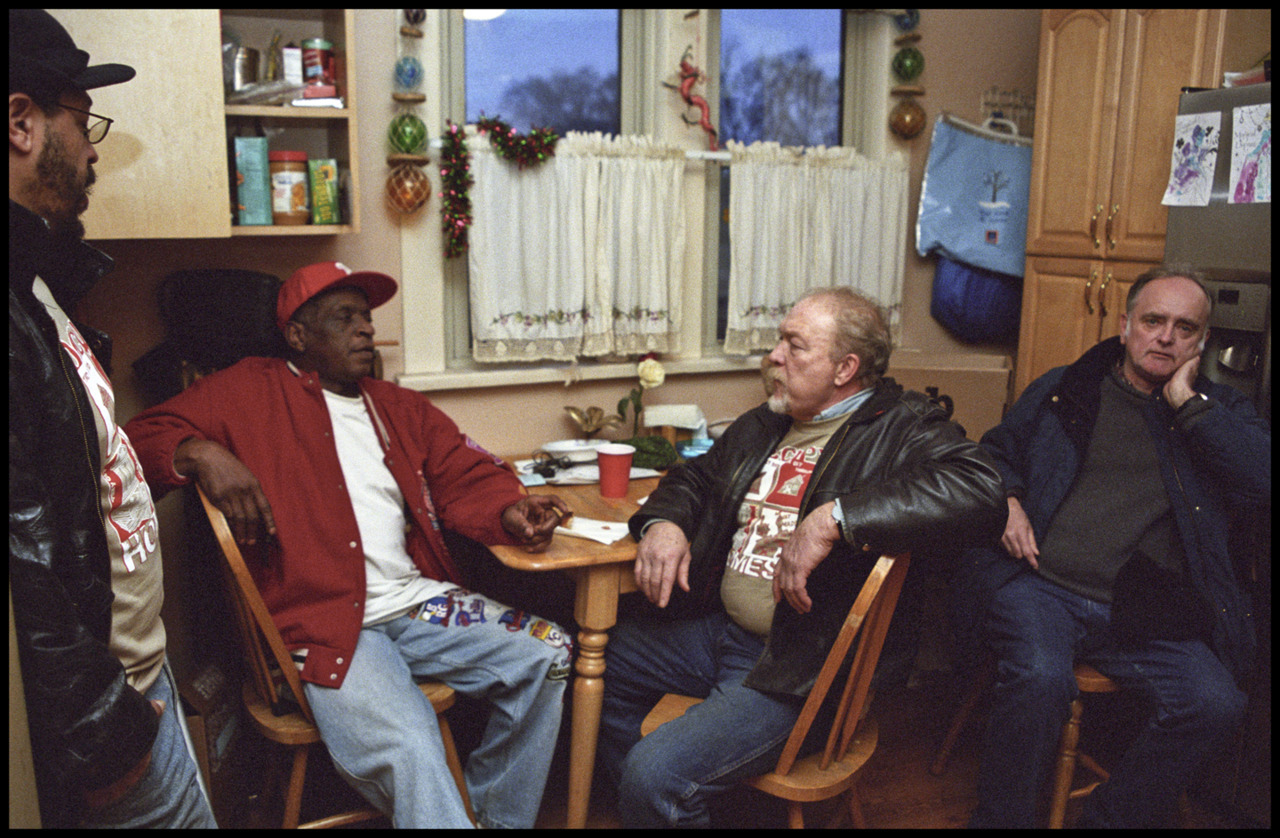
We are the Other - Bobby & Reggie, Minneapolis, Minnesota (2012)
Last November Bobby Hull opened the door of his modest home to a young Occupy Wall Street activist who was canvassing the neighborhood. She asked him if he knew anyone with foreclosure problems. Bobby, a 57-year-old plasterer and former Marine who had fallen behind on his mortgage after a series of health problems, said, “You’re looking at one.”  
Three months later Bobby’s plight has gone national, becoming the forefront of the Occupy Homes movement with coverage from ABC News and the Huffington Post. On February 17th, 2012, his house was the center of a block party “Foreclosure Free Fest” that drew 300 supporters throughout the night, with a line-up of well-known local musicians who performed in his small living room and on a stage in his front lawn.
There were many that night that he didn’t know, but in this photo he’s sitting (on the right) talking to Reggie, who he met in the 7th grade. They both grew up in South Minneapolis. “We ran the neighborhood,” says Bobby. “We fought each other and fought everyone else. But that’s the way it was, you beat someone up and they end up your best friend.”
Bobby, one of nine children, has been in this house since his mother bought it in 1968. She ended up adopting five more before she passed away New Years Day in 1999. Bobby helped raise 47 nephews and nieces. “They all call me mean uncle Bob,” he says. “Children like discipline. It’s a sign of love.”
Having this kind of support seems miraculous to Bobby. “It’s like I fell in the mud and can now come up for clean air all the time.” According to a post six days go in the Huffington Post, Bank of America has offered him a mortgage modification that will allow him to keep his home, thanks partly to the Occupy movement.

Wing Young Huie. Minneapolis, Minnesota. 2012.  
Upon the first glance, the viewer may notice several things about this photo. First, the men are grouped on each side of the image by race, and the African-American men appear to be "the others" as they are on the side of the room without a wall behind them, implying they are the ones who entered and do not stay there. Secondly, the men in the center are sitting facing each other in a seemingly confrontational manner and the other two men are both standing behind the other as a kind of reinforcement. However, upon closer inspection we see some of these are the opposite. The men are seated facing each other at an angle, which to men is usually a body language symbol for trust and familiarity to be side to side or close to that. Also, reading the description gives away that they are in fact life long friends, and instead of arguing they are trying to find out how to keep one of their houses from foreclosing.

Both Margaret Atwood and Wing Young Huie create "othering" by using color and form. In The Handmaid's Tale  social classes/positions are shown by a uniform given a specific color, such as red for the handmaids. This is also shown in the photo by Huie where the different races are split apart and the men on the left are wearing brighter colors and hats. In comparison, only Huie tries to highlight the way the audience others one group by the way he laid out his photograph. By placing the men the way they were, he forms the contrast of races and tries to show the viewer how he/she automatically notices the differences between them and question the way they other one group of people. On the contrary, in The Handmaid's Tale the othering done by Atwood is meant to be seen as  a part of society and not noticed. She does this to emphasize how we may not question a societal norm even if it seems overtly, shown by how the reader just excepts the different positions given to women in THT.