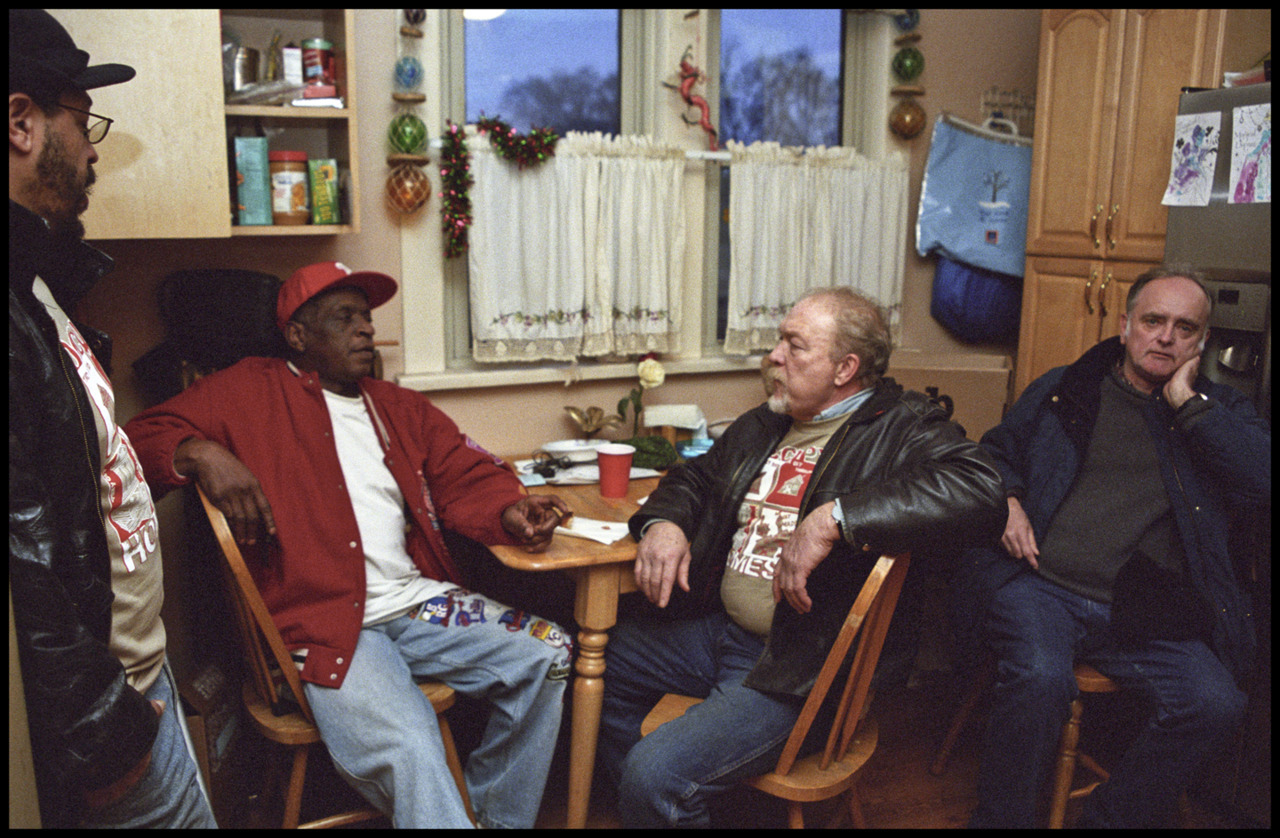
Wing Young Huie. Minneapolis, Minnesota. 2012.
Upon the first glance, the viewer may notice several things about this photo. First, the men are grouped on each side of the image by race, and the African-American men appear to be "the others" as they are on the side of the room without a wall behind them, implying they are the ones who entered and do not stay there. Secondly, the men in the center are sitting facing each other in a seemingly confrontational manner and the other two men are both standing behind the other as a kind of reinforcement. However, upon closer inspection we see some of these are the opposite. The men are seated facing each other at an angle, which to men is usually a body language symbol for trust and familiarity to be side to side or close to that. Also, reading the description gives away that they are in fact life long friends, and instead of arguing they are trying to find out how to keep one of their houses from foreclosing.
Both Margaret Atwood and Wing Young Huie create "othering" by using color and form. In The Handmaid's Tale social classes/positions are shown by a uniform given a specific color, such as red for the handmaids. This is also shown in the photo by Huie where the different races are split apart and the men on the left are wearing brighter colors and hats. In comparison, only Huie tries to highlight the way the audience others one group by the way he laid out his photograph. By placing the men the way they were, he forms the contrast of races and tries to show the viewer how he/she automatically notices the differences between them and question the way they other one group of people. On the contrary, in The Handmaid's Tale the othering done by Atwood is meant to be seen as a part of society and not noticed. She does this to emphasize how we may not question a societal norm even if it seems overtly, shown by how the reader just excepts the different positions given to women in THT.

I like how you thought about composition in both the visual and written text and also how you considered how the artist and author guided the audience/readers' thinking. The structure of your second paragraph is well thought out because of the compare/contrast format- it suits the task well.
ReplyDeleteIn what ways does Offred move beyond her position as an 'other' with the handmaids?
I really like how you compared the ways in which Margaret Atwood and Wang Young Huie structure othering. I agree that Atwood constructed a society in which othering is concealed and meant to be seen as a social norm, and also that Huie's photograph automatically catches the audiences eye on how races are separated. In Atwood's book, othering was intentional; however, with Huie, I do not believe that the goal was to show othering. The fact that the men are old friends supports the idea that there is not intentional othering occurring, even though the audience may have interpreted it that way. I think it is interesting how we automatically notice the separation of races and wonder, is the tendency to notice and create othering a result of society's teaching that othering people is a social norm? Does that make us similar to the society of Gilead?
ReplyDelete